

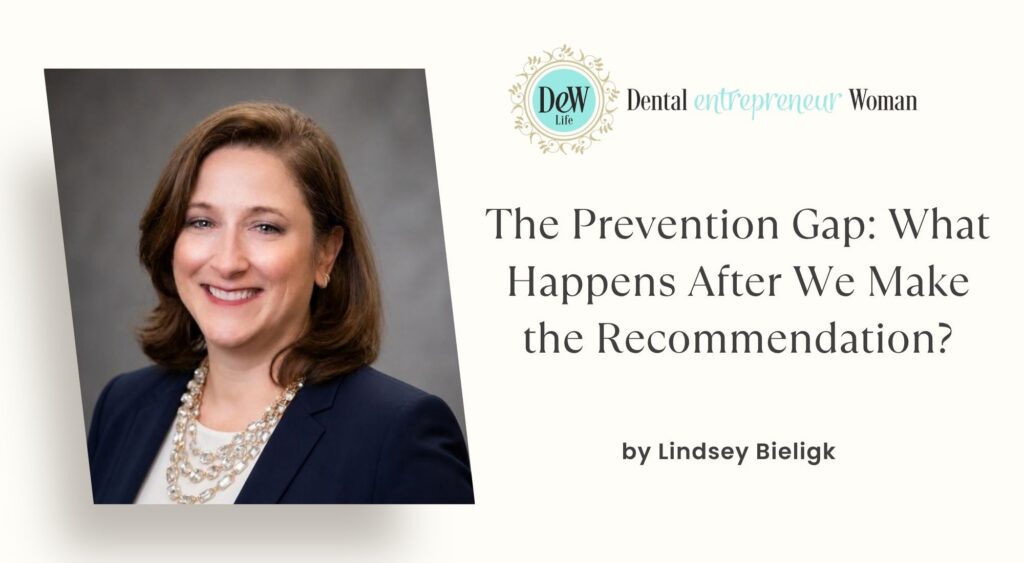
The Prevention Gap: What Happens After We Make the Recommendation?
For most of my career as a dental hygienist, I thought a lot about making the right recommendation.
Did I identify the risk? Did I explain it in a way the patient understood? Did I recommend the right product, treatment, or next step? Did I document it? Did I motivate the patient enough to act?
After 18 years in dental hygiene, my perspective has started to change.
Moving from primarily clinical practice into hygiene leadership gave me the opportunity to step back from a single operatory and see patterns across clinicians, patients, and practices. And I kept noticing the same thing.
We make a lot of really good recommendations.
But what happens next?
The space between knowing and doing
Dentistry has access to more information than ever before. We can identify disease earlier, assess risk more precisely, use advanced diagnostics, explore oral-systemic connections, and personalize preventive care in ways that weren’t possible when I started practicing.
But having more information doesn’t automatically create better outcomes.
A hygienist might recognize a risk factor, educate the patient, recommend a product or diagnostic test, discuss a behavioral change, and document the conversation.
Then the patient walks out the door.
Did they purchase the product? Did they understand why it mattered? Did they use it consistently? Did anyone follow up? And, maybe most importantly, did what we recommended actually change the outcome?
I’ve started thinking of the space between the recommendation and the outcome as The Prevention Gap.
Treatment has a pathway. Prevention often depends on hygiene
Think about what happens when a patient needs restorative treatment.
There is usually a defined pathway: diagnosis, treatment plan, financial conversation, scheduling, reminders, treatment, and follow-up.
Now think about a preventive recommendation.
So much of that process still lives with the individual clinician.
We remember that we talked about dry mouth last time. We remember which toothbrush we recommended. We remember that the patient’s bleeding was worse at the previous visit. We remember the conversation about nutrition, sleep, home care, bacterial testing, or systemic health.
We carry an incredible amount of information about our patients in our heads.
And we’re expected to pick that conversation back up three, four, or six months later.
That’s not because dental professionals aren’t doing enough. If anything, I think it’s the opposite.
We’re asking clinicians to carry too much of the process themselves.
Better diagnostics are only part of the answer
I’m fascinated by where dentistry is heading.
Salivary diagnostics, artificial intelligence, oral-systemic research, personalized risk assessment, and emerging technologies are giving us insights we couldn’t have imagined years ago.
But the more sophisticated our diagnostics become, the more important another question becomes: what are we going to do with all of this information?
The future of prevention can’t simply be about generating more data for clinicians to interpret.
We also need better ways to turn information into action.
That means thinking about what happens after the diagnosis or recommendation: how the next step is communicated, how the patient participates, how follow-through happens between appointments, and how we determine whether what we recommended actually worked.
Technology can help, but I don’t believe the goal should be replacing clinical judgment. It should be supporting it.
The question I couldn’t stop asking
I didn’t set out to become an entrepreneur.
I became curious about a problem I couldn’t stop seeing.
That curiosity eventually led me to begin building Dental Innovations Group and exploring how technology and better workflows might help close the space between clinical insight and patient action.
I’m still early in that journey, and I’m learning constantly. I know a lot of you reading this are somewhere in that same uncertain early stretch, whether it’s your own venture or just the first version of an idea you can’t stop thinking about, and I don’t think that uncertainty ever fully goes away, you just get more comfortable building alongside it.
But I’ve become convinced that some of the biggest opportunities in preventive dentistry may not come from discovering one more thing about our patients.
They may come from getting better at acting on what we already know.
So lately, when I think about the future of dental hygiene, I keep coming back to one deceptively simple question:
What happens after we make the recommendation?
Because making the right recommendation matters.
Making sure it has the opportunity to become a measurable outcome may matter even more.
Lindsey Bieligk, MSDH, BSDH, is a dental hygienist, hygiene leader, and founder of Dental Innovations Group. With 18 years of clinical and leadership experience, she is focused on what she calls the “The Prevention Gap”–the space between identifying risk, making a clinical recommendation, and achieving measurable patient action and outcomes. Her work explores how better workflows, technology, and clinical insight can help move preventive dentistry from recommendation to meaningful follow-through.